Start the game
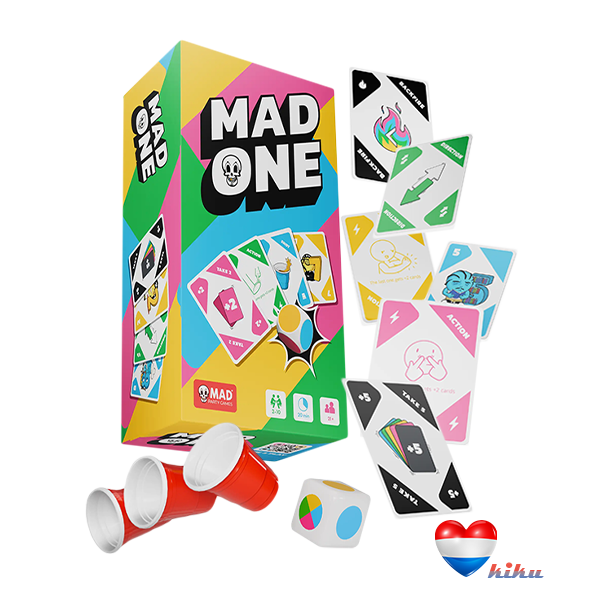
To begin, shuffle the deck well and deal 8 cards to each player.
Place the remaining cards on the table, exactly the same way as in a regular game of Uno.
Rules
Draw the first card from the deck and place it on the table. If it’s a special card, put it back into the deck and draw another one (again, just like in Uno).
The game is played clockwise and starts with the youngest player.
Each card has two attributes: a color and a number. For example, if I play a blue ten, you—as the next player—can play either a blue card or a ten (again, just like in Uno).
The only special cards that can be played at any time are the black cards (once again, just like in Uno).
If it’s your turn and you can’t play a card, you draw one from the deck. If the drawn card can be played, you place it immediately; if not, you skip your turn (again, just like in Uno).
When you play your second-to-last card and are left with only one card in your hand, you have to shout Mad — exactly the same way you shout Uno in Uno.
Your final card cannot be an action card. If you’re left with an action card as your last card, that’s a penalty and you must draw 2 cards.
Now you might be thinking: so how is this any different from Uno?
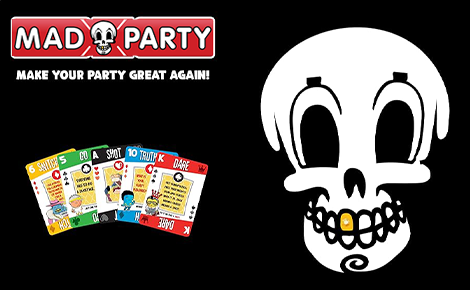
The real difference—the thing that gives this game a completely different vibe—is the Action cards. And the action cards are the following:
- Skip – the next player skips their turn (this exists in regular Uno too, we know).
- Direction – if the game was going clockwise, it now switches to counterclockwise, and vice versa (this is also in Uno, we know).
- Again – when you play this card, it’s your turn again.
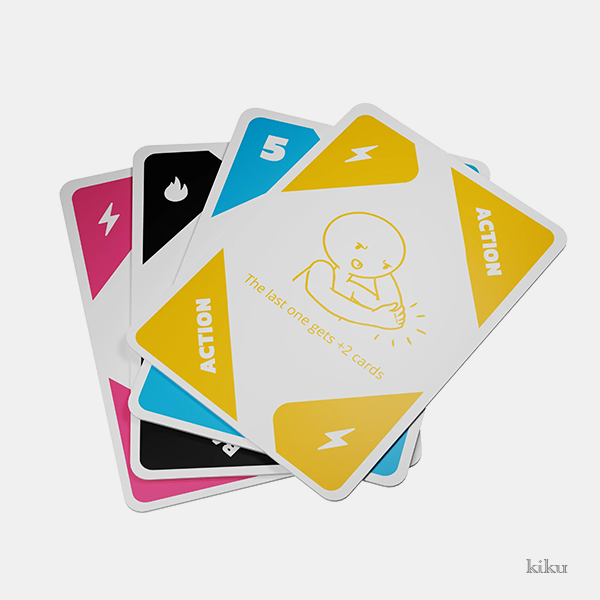
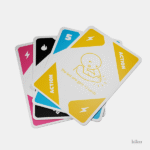
- Action – this card always has some kind of action illustrated on it, like putting your hand on your foot or something similar. When it’s played, everyone must quickly perform the action shown on the card. Whoever is last has to drink.
- When you play this card, everyone passes their cards to the player next to them. You choose whether the cards are passed to the right or to the left. You also choose which color the game continues with.
- Take 2 – a pretty straightforward card: if you play it, the next player in turn has to draw 2 cards.
- Take 5 – this one is also pretty clear: if you play it, the player next to you draws 5 cards, and you also choose the color the game continues with.
Here’s the important part: for example, if you play a +2 and the next player also has a +2 or a +5, they can play it as well, and then the following player has to draw the total number of cards.
So let’s say you play +2, the next player also plays one, the next one does the same, and the next one too. The player after them—if they don’t have a similar card, +5 or Backfire—will have to draw 8 cards.
- Backfire – this card only has power when it’s played on top of a +2, +5, or Shot card. Backfire means that whatever penalty was meant for you now boomerangs back to the previous player.
In any other situation, you can still play this card, but it won’t have any special effect other than letting you choose the color the game continues with.
- Shot – if this action card is played on you, you have to take a shot. If you also have this action card, you can play it too, and then the next player will have to take 2 shots in a row.
If they also have the card, they can play it as well, and someone might end up having to take 3, 4, or even 5 shots in a row—unless they manage to reverse it back with a Backfire 🙂
- Roll – here you roll the die. The person who plays this card is the one who rolls it. So if you play it, you roll the die yourself, not the next player.
Rolling the die is almost like hitting the jackpot. When you roll it, the die can land on pink, yellow, blue, green, a mix of all four colors, or +2.
If it lands on pink, it means you can discard all your pink cards.
If it lands on blue, it means you can discard all your blue cards.
If it lands on green, it means you can discard all your green cards.
If it lands on yellow, it means you can discard all your yellow cards.
If it lands on the mix of colors, it means you get to choose which color cards you discard.
If it lands on +2, that means you got unlucky and simply have to draw 2 cards from the deck.
One more thing to keep in mind: when discarding cards because of the die, you might drop several action cards. For example, you might discard a blue Direction, Again, Action, and Shot. In this case, you choose which card you place last—but only that last card will have an effect. All the others are simply discarded without any effect.
If the deck runs out of cards, you shuffle the already played cards and form a new deck—again, exactly like in Uno.
Have fun 🙂


 თბილისში 14:00-მდე გაკეთებული შეკვეთები იმავე დღეს მოგეწოდება